From Exploration to Commitment: How Experiential Design Speeds Decisions
· Abhirami S
In luxury real estate, long sales cycles are rarely caused by a lack of interest. They are caused by unresolved questions.
Buyers hesitate not because they don’t like what they see, but because they are unsure of what they don’t see yet. Every unanswered detail adds friction. Every assumption adds delay.
This is where experiential design begins to influence sales velocity.
The Shift: From Explanation to Exploration
Traditional sales journeys rely heavily on explanation - brochures, scale models, conversations, and follow-ups. Each interaction fills a gap, but also extends the timeline.
Experiential design changes this dynamic.
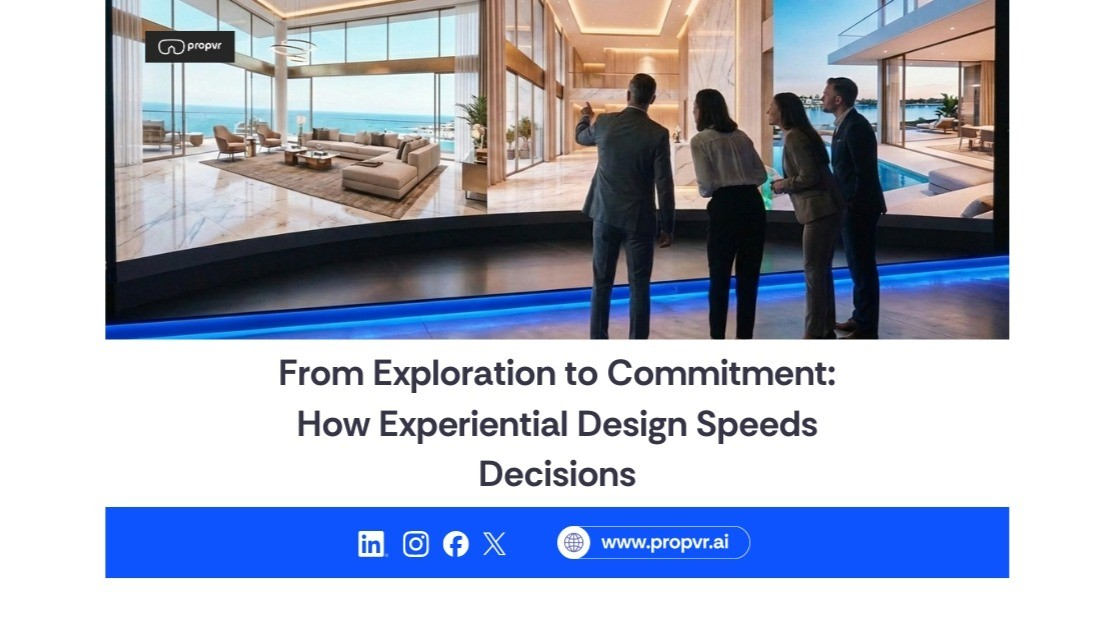
By allowing buyers to explore spaces on their own terms, it compresses multiple stages of the decision process into one. Layout clarity, spatial understanding, and context are absorbed intuitively, not explained repeatedly.
When buyers explore instead of being guided, comprehension happens faster.
Why This Accelerates Decisions
Sales velocity improves when friction is removed early.
Experiential environments reduce:
- Repeated clarification calls
- Back-and-forth layout discussions
- Late-stage expectation mismatches
Buyers arrive at conversations better informed and more decisive. Instead of asking ‘what if’, they ask ‘what’s next’.
This doesn’t just shorten decision cycles; it improves their quality. Faster decisions are not rushed decisions. They are confident ones.
Beyond Speed: The Compounding Effect
The impact of experiential design extends beyond a single sale. Faster clarity leads to cleaner pipelines, stronger buyer qualification, and fewer drop-offs mid-journey.
In high-value markets, speed is not about urgency. It’s about certainty delivered early.
When understanding replaces interpretation, momentum builds naturally.
And in a market where trust determines timelines, experiential design doesn’t just support sales velocity, it becomes one of its strongest drivers.