Spatial Lite : Immersive real estate projects in your browser
· Abhirami S
The brochure problem.
“Can you send me the brochure?” It’s one of the most common questions a real estate sales team hears, and brochures were never built to answer it.
A brochure can tell a buyer that a project has a clubhouse, show them the pool, and note that the metro is ten minutes away. What it can’t answer are the questions buyers actually care about:
- Which tower is closest to the park?
- Will my balcony face the sunrise or another building?
- How far is my apartment from the clubhouse?
- What does the view from the 18th floor actually look like?
Open almost any property website today, and the pattern is familiar: a few renders, a floor plan, a location map, maybe a flythrough, and a contact form. It delivers information. It doesn’t convey what living there will feel like, and for a generation of buyers, that gap now decides the sale.
The buying journey has changed.
Think about your last major purchase. A car, probably: you compared models online, configured trims, watched reviews, maybe took a virtual tour, all before setting foot in a showroom.
Now compare that to buying a home worth ₹1 crore, ₹5 crore, or more, where buyers are still handed static renders, PDF brochures, and pre-recorded videos. The irony is hard to ignore: the larger the investment, the less interactive the experience becomes.
This matters most for the buyers driving today's demand, younger, digital-first customers, and the NRIs, international investors, and outstation buyers who may never visit a sales gallery before deciding. In fact, NRI investments account for roughly 20–25% of India's luxury residential sales, making remote buyer engagement more important than ever.
They want to explore before they enquire, and understand before they commit. Above all, they want confidence, the same confidence as someone walking through a model apartment, delivered to a buyer sitting thousands of kilometres away.
The gap isn’t content, it’s connection.
Developers already invest heavily in renders, brochures, videos, websites, floor plans, and sales presentations. The problem is that none of it connects. The tower render lives in one place, the inventory sheet in another, the floor plan inside a PDF, and the location on a separate page.
So buyers spend more time imagining a project than understanding it, especially for under-construction developments that may be years from completion. The question is no longer how to create more content. It’s how to connect what already exists into a single experience.
What is Spatial Lite?
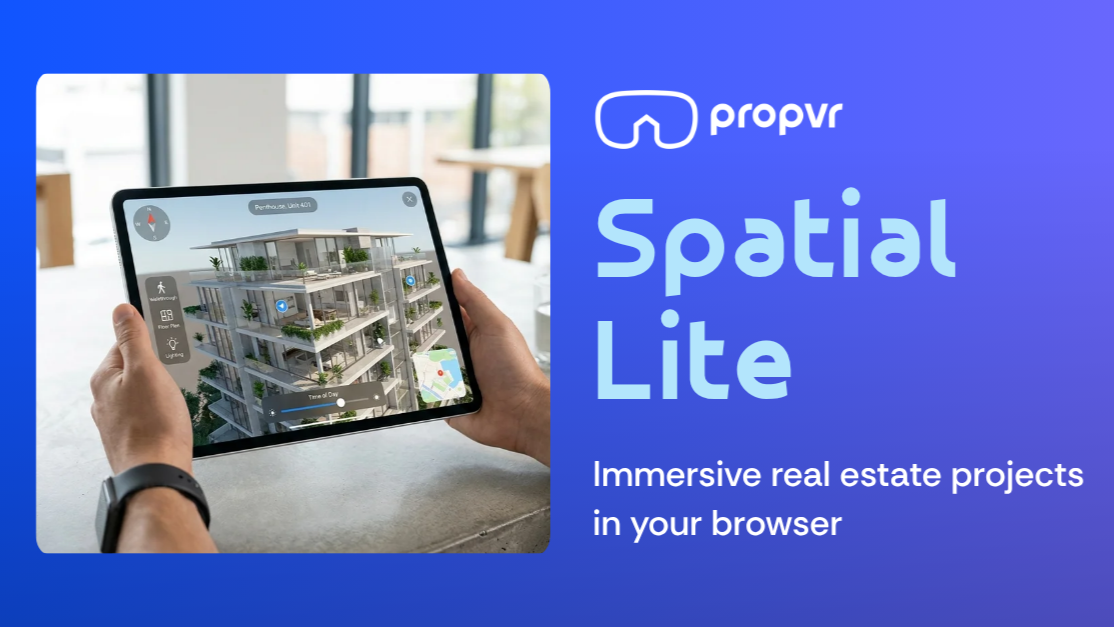
Spatial Lite is a web-based property exploration platform built to close that gap. Instead of presenting a project through static content, it lets buyers actively explore it in their browser.
Developed by PropVR, Spatial Lite builds on years of experience creating immersive sales experiences for real estate developers across India and the Middle East.
A buyer opens a link on a laptop, tablet, or phone and enters an interactive environment - navigating the development, exploring buildings, viewing available inventory, comparing units, and experiencing amenities. No app to install, no special hardware. For developers, it effectively turns a project website into a digital sales gallery that’s open 24 hours a day.
How a buyer explores a project?
The platform is built around one connected journey, replacing a scatter of documents and phone calls:
- Open the project link
- Explore the interactive masterplan
- View nearby landmarks and connectivity
- Browse available inventory in real time
- Compare floor plans and unit layouts
- Step inside interiors through 360° tours
- Explore amenities and community spaces
- Contact sales or initiate a booking
The masterplan, made interactive.
Traditional marketing offers a bird’s-eye render, visually impressive, but it doesn’t show how the parts of a community relate. Spatial Lite lets buyers move through towers, parks, retail zones, amenity spaces, and access roads while keeping the whole layout in view. People don’t just buy apartments; they buy communities and everyday experiences, and where a unit sits often shapes the decision as much as the floor plan.
Real-time inventory, not a stale spreadsheet.
Inventory is one of the most common frustrations in real estate sales: a buyer picks a unit, contacts the team, waits, and learns it’s already sold. Across hundreds of weekly enquiries, those small delays compound into calls, checks, and follow-ups.
Spatial Lite integrates directly with inventory and CRM systems, so availability updates in real time. Buyers filter by floor, bedroom count, unit type, price range, and view direction, and see exactly what’s available, turning “which units are free?” into something they can answer themselves.
Floor plans and interiors brought to life.
Floor plans are essential and routinely misread. A 2D drawing communicates dimensions but rarely how a space will feel to live in. Spatial Lite pairs interactive floor plans with 360° walkthroughs, so living rooms, kitchens, bedrooms, bathrooms, and balconies become easier to grasp than they are on paper. The same applies to amenities: rather than static photos of a pool or clubhouse, buyers tour them. For under-construction projects, this closes much of the gap between imagination and reality.
Beyond buyer engagement.
Spatial Lite also gives developers something brochures never could: data. Every interaction can be tracked, which towers draw the most attention, which units generate the highest interest, how long buyers explore specific areas, and where engagement drops off.
That helps sales teams prioritise high-intent leads. A buyer who spends fifteen minutes comparing three-bedroom apartments across several floors is far closer to a decision than one who lingers on a homepage for thirty seconds, a signal that simply doesn’t exist in a static website.
Why it matters now?
Real estate marketing spent the last decade moving brochures online. The next decade is about making property exploration interactive. Buyers now expect the same control they have when researching cars, booking hotels, or planning travel, to compare, explore, and evaluate before they ever speak to a sales rep.
Spatial Lite is built around that shift. It extends the sales gallery beyond four walls and into any browser, on any device, anywhere in the world. For developers selling to increasingly digital and dispersed audiences, that’s no longer a nice-to-have.
It is rapidly becoming an expectation.