What Is an Experience Centre? The Complete Guide for Indian Property Developers
· Abhirami S
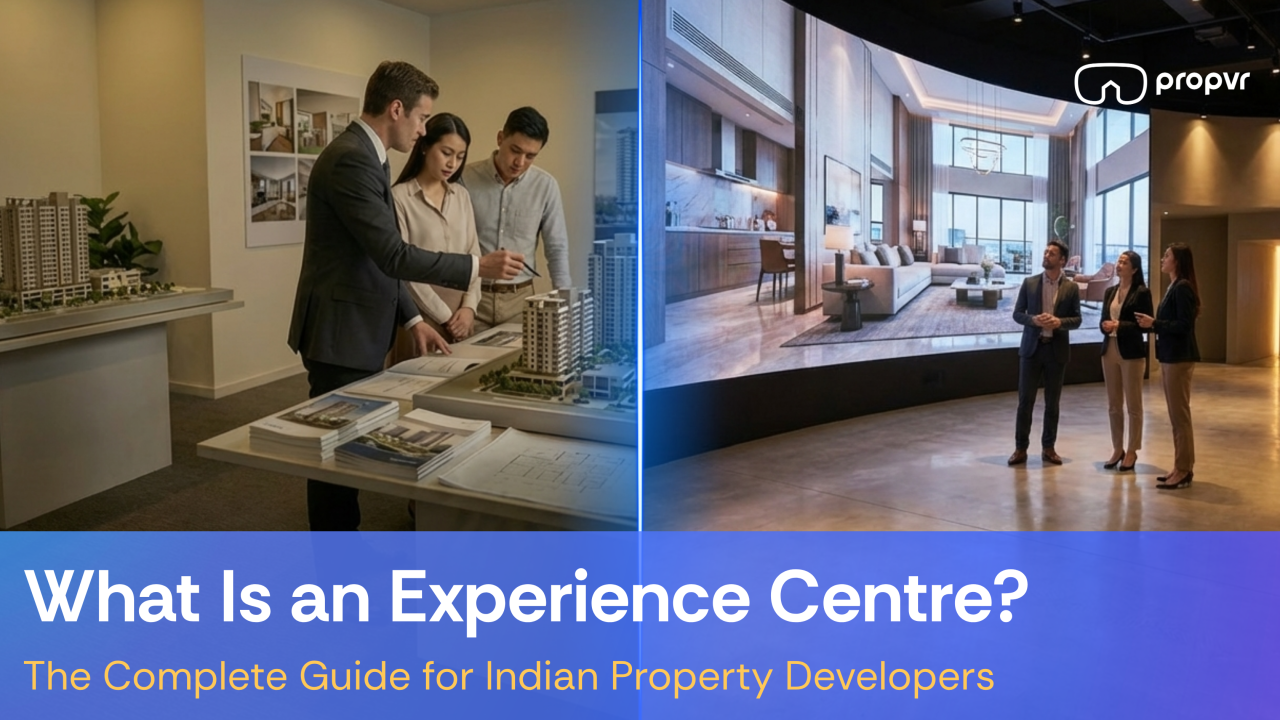
Walk into any premium real estate sales office in Mumbai, Bengaluru, or Hyderabad today, and the shift is obvious. The traditional sales gallery, printed floor plans, static scale models, and looping flythrough videos are rapidly being replaced by the experience centre.
But what exactly is an experience centre? How is it different from a sales gallery? Why are developers investing heavily in them? And most importantly, how do you build one that actually drives sales? sales
This guide answers those questions for developers planning their first experience centre or upgrading an existing sales office.
1. Defining the Experience Centre
An experience centre is a technology-integrated space where buyers can experience a property before it is built, not just see it, but feel what it would be like to live there. It combines immersive 3D visualisation, interactive displays, spatial storytelling, and guided sales conversations into a single, curated environment.
Unlike a traditional sales gallery that displays information, an experience centre immerses buyers inside the project. Instead of imagining a living room from a 2D floor plan, buyers can walk through a realistic digital version of it. Instead of studying a site map, they can explore a master plan interactively and understand tower placement, amenities, and views.
This matters because Indian homebuyers are making decisions worth ₹50 lakhs to ₹10 crores on homes that may not be ready for years. The experience centre bridges the gap between a blueprint and the buyer’s imagination.
2. Why Indian Developers Need Experience Centres Now
Several converging forces are making experience centres essential, not optional, for Indian property developers in 2026.
The Informed Buyer
Today’s buyers arrive after researching online listings, satellite views, pricing, and competitor projects. Printed brochures and rehearsed sales pitches no longer create impact. Buyers expect a presentation that reflects the quality of the project itself. ₹2-crore apartment demands a ₹2-crore presentation.
The Under-Construction Reality
India’s real estate market is overwhelmingly pre-launch and under-construction. Buyers are purchasing homes they cannot visit, in buildings that do not yet exist. Traditional tools, renders, brochures, and sample flats leave too much to the buyer’s imagination. Experience centres fill this gap by making the unbuilt tangible and the intangible visible.
Competitive Differentiation
In competitive micro-markets like Whitefield, Worli, Gachibowli, or Dwarka Expressway, developers often sell similar products at similar price points. The experience centre becomes a key differentiator that influences booking decisions.
NRI and Remote Buyers
NRI buyers contribute significantly to premium housing sales. They cannot frequently visit project sites in India. Experience centres equipped with VR and cloud-based walkthroughs allow developers to deliver immersive sales experiences remotely to buyers in Dubai, London, or San Francisco.
3. Experience Centre vs. Traditional Sales Gallery
Traditional sales galleries rely on printed brochures, static renders, physical models, and sample flats. Buyers remain passive viewers.
Experience centres replace this with immersive 3D walkthroughs, holographic masterplans, VR tours, and interactive displays where buyers actively explore the project.
Traditional galleries usually showcase only one or two unit types and cannot demonstrate exact views, lighting, or spatial experiences. Experience centres allow buyers to compare units, explore layouts, and even simulate sunlight conditions in real time.
They are also easier to scale. Instead of rebuilding physical models and reprinting materials for every project, developers can manage multiple projects through a single digital platform.
4. The Core Components of a Modern Experience Centre
Building an effective experience centre is not about buying the most expensive screens. It is about designing a buyer journey, a sequence of touchpoints that progressively builds emotional connection, spatial understanding, and purchase confidence. Here are the essential components.
A. Immersive Room (The Wow Moment)
The centrepiece of any experience centre is the immersive room, a multi-screen or LED-wall environment that wraps the buyer in a 180° to 360° visual narrative. This is where the developer tells the story of the project: the neighbourhood, the lifestyle, the amenities, and the vision.
Solutions like PropVR’s Spatial Cave deliver this as a complete package, LED walls or projection systems, purpose-built control software, Unreal Engine real-time 3D content, and a storytelling application, all from a single partner. The room does not just display content; it responds to the audience, transitions between project phases, and delivers a cinematic experience that static screens simply cannot match.
B. Interactive Masterplan Display
Physical scale models have been a staple of Indian sales galleries for decades. But they are expensive (₹10–25 lakhs each), cannot be updated, and show only the exterior. A modern experience centre replaces the static model with an interactive digital alternative.
PropVR’s Spatial Holo displays a photorealistic, interactive 3D holographic model inside a transparent display cabinet. Buyers can rotate, zoom, select individual buildings, explore floor plans, and view isometric layouts of specific units, all through touch. Available in Cube (vertical, ideal for towers) and Vista (horizontal, ideal for villas and masterplans) formats, Spatial Holo replaces the static scale model with something buyers can actually interact with.
For developers who want a tangible, physical interaction, Spatial Table offers a dual-display system where visitors place physical Tags on a tabletop floor plan to trigger corresponding 3D visualisations on a connected wall display. The act of physically placing a marker on a unit creates an intuitive, memorable connection that touchscreens cannot replicate.
C. VR Walkthrough Zone
Virtual reality lets buyers step inside their future home at 1:1 scale. But VR adoption in real estate has been held back by a basic problem: most homebuyers are not tech-savvy. Handing someone a VR headset with joystick controllers and expecting them to navigate creates confusion and frustration.
PropVR’s Spatial Tour solves this with a guided VR platform where the sales agent controls the experience from a tablet while the buyer simply wears the headset and enjoys the walkthrough. The agent selects projects, switches floor plans, and navigates spaces; the buyer sees it all unfold in real time. The complete kit includes a 65-inch TV for spectators, a control tablet, and multiple VR headsets, all operating offline with zero internet dependency.
D. Photorealistic 3D Walkthrough Stations
Not every buyer wants to wear a VR headset. Walkthrough stations on large touchscreens offer an alternative: buyers explore units in a gamified, open-world style, walking through rooms, opening doors, stepping onto balconies, and seeing how sunlight enters each room at different times of day.
PropVR’s Spatial Twin delivers these experiences at photorealistic quality with three exploration modes: Walk, Fly, and View. A real-time day-and-night simulator lets buyers see exactly how their apartment will look from sunrise to midnight. The gamified discovery layer keeps buyers engaged 3–5 times longer than traditional virtual tours — turning a glance into an 8–15 minute deep exploration.
5. Designing the Buyer Journey: From Entry to Booking
The best experience centres function as guided narratives rather than collections of gadgets.
Welcome and Brand Story - The journey begins in the immersive room, where buyers experience the project story, lifestyle, and developer vision.
Masterplan Exploration - Buyers then interact with holographic or tabletop master plans to understand tower placement, amenities, green spaces, and connectivity.
Unit Selection and Walkthrough - Next, buyers explore specific unit types through VR or touchscreen walkthroughs. They can experience views, lighting, layouts, and finishes.
Comparison and Customisation - Technology allows buyers to compare unit types, floors, and configurations easily, helping them make informed decisions.
Consultation and Booking - Once buyers gain spatial understanding and emotional confidence, the sales discussion around pricing and booking becomes smoother and faster.
6. Common Mistakes to Avoid
Buying Hardware Without a Content Strategy - An LED wall without purpose-built software or storytelling is simply an expensive display. Technology should support the sales narrative.
Multi-Vendor Assembly - Using separate vendors for hardware, software, and content often creates integration issues and accountability problems.
Ignoring the Sales Team - If the system is too technical for sales teams to operate easily, adoption will fail. The entire experience should be manageable through a simple interface.
Building for One Project Only - A modern experience centre should support an entire project portfolio, not just a single launch.
Neglecting Remote Buyers - Without remote walkthrough capability, developers miss opportunities with NRI and outstation buyers.
7. The ROI Case: Why It Pays for Itself
Developers often question whether experience centres justify the investment. In most cases, the returns are significant.
Faster Conversions - Immersive experiences help buyers understand projects quickly, reducing delays in decision-making.
Higher Price Realisation - When buyers clearly experience layouts, finishes, and views, they are often more comfortable paying premium prices.
Reduced Sample Flat Costs - Physical sample flats can cost ₹30–80 lakhs and represent only one layout. Digital walkthroughs can showcase every unit type more efficiently.
Portfolio Scalability - A platform-based setup supports future projects without rebuilding the entire experience infrastructure.
Stronger Brand Perception - A high-quality experience centre positions the developer as innovative, professional, and future-focused.
8. Getting Started: The PropVR Approach
PropVR’s Spatial OS platform is purpose-built for experience centres. Every product - Spatial Cave, Spatial Holo, Spatial Table, Spatial Tour, Spatial Twin - runs on the same platform, shares the same 3D assets, and is managed through a single CMS. This means content created for one product is instantly available across all others. No duplication, no additional production cost, no vendor coordination.
Whether you are setting up a flagship experience centre for a large township or adding immersive technology to an existing sales office, the Spatial OS ecosystem scales to your needs - from a single Spatial Holo unit to a full multi-room immersive environment.